Academy of the Fine Arts Founded in 1805 and Led by Thomas Eakins in the 1880s
The White Business firm Collection
-
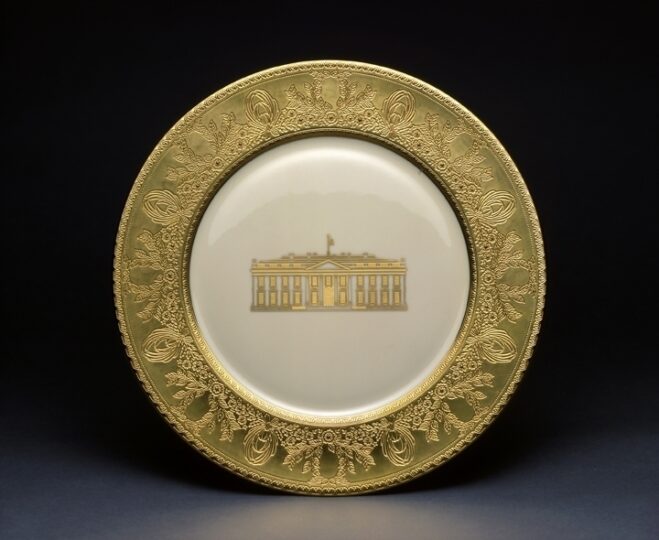
![200th Anniversary China: Plates]()
Dinner plate, dejeuner/fish plate, for 200th Anniversary China manufactured by Lenox. Debuted November ix, 2000.
Gift of White House Acquisition Trust
-
!["View of Lake George"]()
View of Lake George, c. 1850-1860, attributed to Andrew Andrews
Gift of the White House Historical Clan, 1975.
-
!["Sailing off the Coast"]()
Sailing off the Coast, 1869, by Martin Johnson Heade
Souvenir of the White House Historical Association, 1980.
-
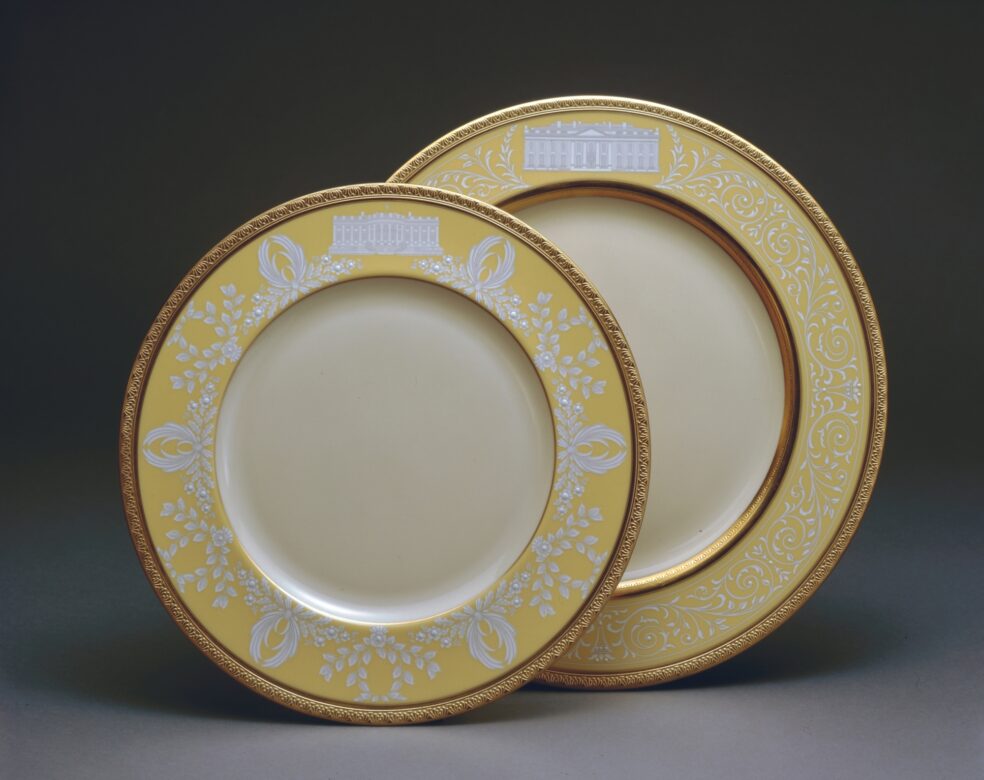
![200th Anniversary China: Service Plate]()
Service Plate Blueprint, for 200th Ceremony Red china manufactured by Lenox. Debuted November 9, 2000.
Souvenir of White House Acquisition Trust
-
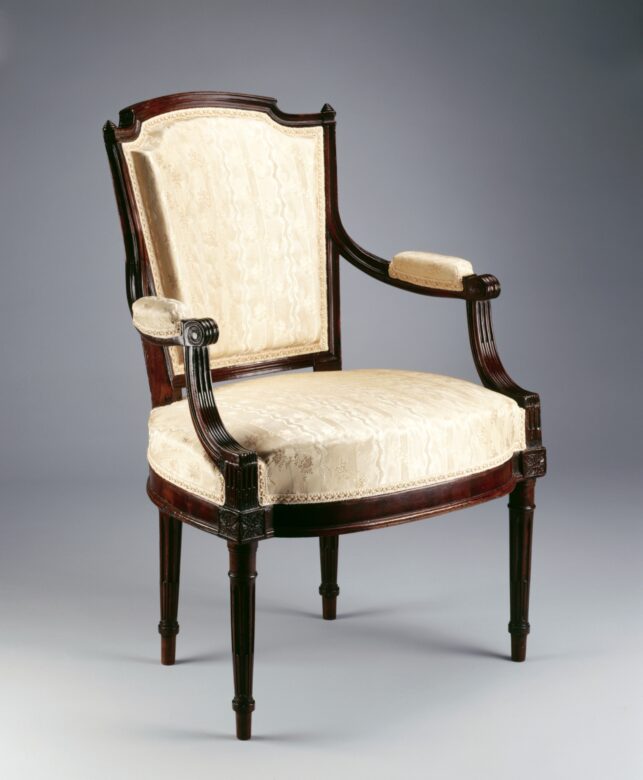
![Armchair]()
Armchair, c. 1793-97
A gift of Mr. and Mrs. Shepley Evans and the White Business firm Historical Association, 1975.
-
![Chinese Tea Box]()
Chinese tea box, c. 1811. The pink-footing French wallpaper lining is believed to accept been installed in the White House before the 1814 fire.
White House Conquering Fund, 1971
-
![Cylinder Desk]()
Cylinder Desk-bound with a bookcase, crafted c. 1830
Gift of the White Firm Acquisition Trust in 2000
-
![French Porcelain Vases]()
2 French porcelain vases with the painted images of George Washington and John Adams, c. 1820.
Gift of the White House Historical Clan in 2000
-
![Goblet]()
Goblet, c. 1840-60
Souvenir of the White House Historical Clan, 1993
-
![Rug Design]()
Carpeting Design, Bolletin and Thompson for Tiffany studios, 1926
Gift of the White Firm Historical Association, 1995
-
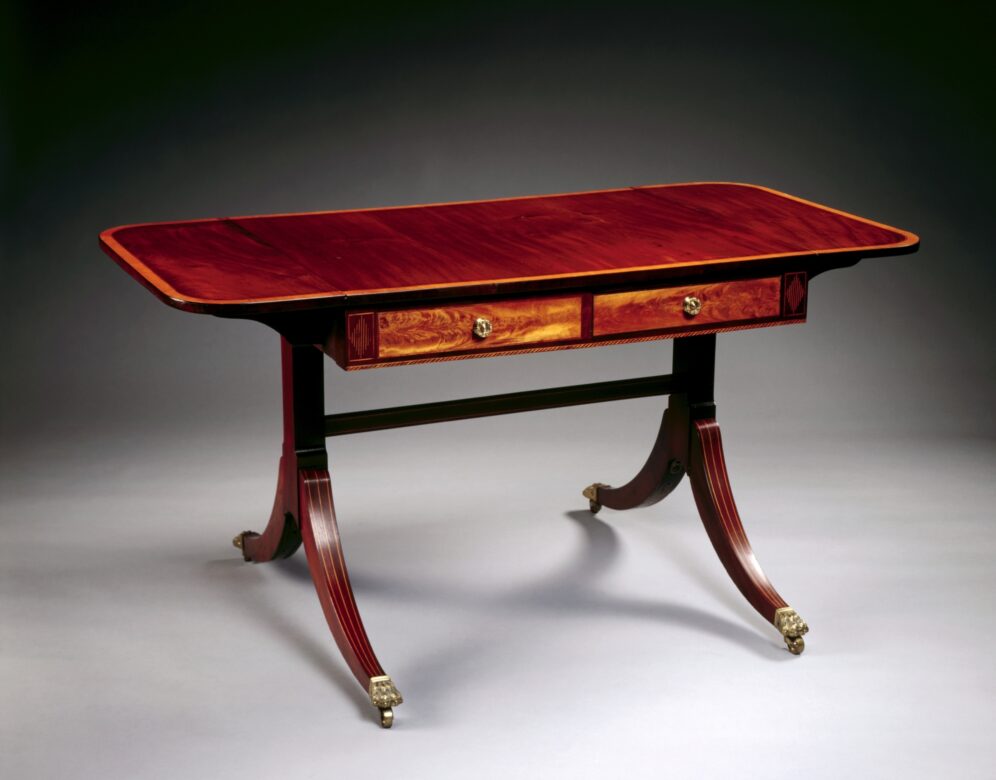
![Sofa Table]()
Sofa Table, c. 1805-ten
Souvenir of the White Business firm Historical Association, 1975
-
![Tall Case Clock]()
Tall case clock, c. 1795-1805
Gift of the White House Historical Clan, 1972
-
![William Howard Taft Etching]()
William Howard Taft, 1911, etching by Anders L. Zorn
Souvenir of the White House Historical Association, 1989
-
![Treasures of the White House: "Resolute" Desk]()
880.177. ane
This double pedestal partners' desk, usually called the "Resolute desk", was fabricated from the oak timbers of the British ship H.M.South. Resolute as a souvenir to President Rutherford B. Hayes from Queen Victoria in 1880. It has been used by every president since Hayes, excepting Presidents Johnson, Nixon, and Ford, 1964-1977.
It was used in the President's Office on the Second Flooring of the Residence from 1880 until 1902, at which time the role was moved to the newly synthetic West Wing. This desk-bound remained, however, on the 2d Floor of the Residence in the President'due south Written report. President Franklin D. Roosevelt requested that the rear kneehole be fitted with a panel carved with the presidential coat-of-arms, only he did not alive to run across it installed in 1945.
Later on the Truman Renovation of the White Firm, 1948-1952, information technology was placed in the Broadcast Room on the Ground Floor where it was used by President Dwight D. Eisenhower during radio and television receiver broadcasts. It was first used in the Oval Office in 1961 at the asking of President John F. Kennedy. After President Lyndon B. Johnson selected another desk for his office, it was lent to a Kennedy Library traveling exhibition, 1964-1965, and then to the Smithsonian Institution for exhibition, 1966-1977.
In Jan 1977, President Jimmy Carter requested that this historic desk exist returned to the White House for use again in the Oval Office. In 1981, President Ronald Westward. Reagan as well chose to utilise this desk in the Oval Part. President George Bush used information technology in the Oval Role for v months in 1989 earlier having information technology moved to his Residence Function in exchange for a partner's desk which he had used in his West Wing office as Vice President. It was returned to the Oval Office for apply past President Neb Clinton, 1993-2001. President George W. Bush has chosen to continue using it in the Oval Office.
A brass plaque affixed to the desk records the history of its creation:
"H.K.S. 'Resolute', forming part of the expedition sent in search of Sir John Franklin in 1852, was abandoned in Breadth 74º 41' Northward. Longitude 101º 22' W. on 15th May 1854. She was discovered and extricated in September 1855, in Latitude 67º N. by Captain Buddington of the U.s.a. Whaler 'George Henry'. The ship was purchased, fitted out and sent to England, equally a gift to Her Majesty Queen Victoria past the President and People of the United States, as a token of goodwill & friendship. This tabular array was made from her timbers when she was broken upwards, and is presented by the Queen of Bang-up Britain & Ireland, to the President of the United states, as a memorial of the courtesy and loving kindness which dictated the offer of the gift of the "Resolute'."
Role of the Curator, The White House
Gift of Queen Victoria, 1880
-
![Treasures of the White House: Abraham Lincoln]()
Signed and dated lower left: M.P.A. Healy / 1869
939.1388.one
Lincoln's terminal public accost was delivered on April 11, 1865, from a window higher up the northward door of the White Firm, two days subsequently the Confederate surrender at Appomattox Court House. His subject-was national reconciliation and the reconstruction of the South, and he concluded: "I am considering, and shall non neglect to deed, when satisfied that action volition be proper." With his death just days later all action was ended, but in this portrait he is nevertheless considering, and he seems to nourish to other voices.
Healy had begun work on a portrait of Abraham Lincoln for which the President had saturday in August 1864. The assassination, however, turned the creative person's thoughts in another direction, and he conceived The Peacemakers, the pocket-sized version of which was completed belatedly in 1868. In The Peacemakers Lincoln leans forward, listening attentively to General Sherman'southward urgings, equally he habitually did to the advice of his counselors before offering his own pondered decisions. In the 1869 portrait Healy had the artistic inspiration of his career. He made the decision, no less pondered, to remove the president from all human associates while preserving the listening, absorbed pose.
The portrait was painted in Paris and sent to Washington in response to an act of Congress (March three, 1869) authorizing a Lincoln portrait for the White House. When President Grant chose another likeness by William Cogswell, Lincoln'south son Robert Todd Lincoln purchased the Healy, later declaring that "1 have never seen a portrait of my father which is to be compared with information technology in any way."
Source: William Kloss, et. al., Art in the White Business firm, New York: Abrams, 1992.
Heritance of Mrs. Robert Todd Lincoln, 1939
-
![Treasures of the White House: Adams' Tea or Coffee Urn]()
This Sheffield silverplate urn, made in England, circa 1785-88, was in one case owned by John and Abigail Adams, the kickoff occupant of the President's Business firm in 1800. This neoclassical vase-shaped urn, a type pop in England circa 1770-1800, was perchance caused when Adams was American minister to England (1785-88). The front is engraved with the cypher "JAA" in a form found on some family silver documented in the inventory taken at Adams' death in 1826. It descended in the Adams family until it was sold in 1946.
Role of the Curator, The White Firm
Gift of Mr. and Mrs. Mark Bortman and Jane Bortman Larus, 1964
-
![Treasures of the White House: Angelica Singleton Van Buren]()
Signed and dated, vertically at left edge on balustrade: H. Inman. I 1842.
890.2061.i
Martin Van Buren, eighth President, had been a widower for 18 years when he moved into the Executive Mansion in 1837. He was never to remarry, then the Van Buren White House lacked a hostess until that role was filled in 1839 by Angelica Singleton Van Buren (1817–1878). She was a native of South Carolina, the daughter of a wealthy and well-connected cotton fiber planter and a relative by matrimony of Dolley Madison, social doyenne of the capital. It was through Mrs. Madison that she met Van Buren's son and private secretary, Abraham, at the White House. They were married in November 1838, and on New year'due south Day 1839 Angelica became the president'southward official hostess.
Inman displays artistic diplomacy in his handling of the marble bust of Martin Van Buren on the right. Tricks of perspective make the sculpture appear to be farther back in the picture space than in fact is logical. Inman reduces the sculpture'southward actual size equally well, then information technology does not compete with the head of Angelica. At the same time he strongly–and arbitrarily–spotlights information technology, thus ensuring that the president will not fade into insignificance.
Inman's Angelica is so winning in her frank expression and her womanly warmth that a dominant trait of her personality is quite obscured–hauteur. She and her husband had gone in the bound of 1839 to Europe, every bit ambassadors-without-portfolio. Angelica had been mightily impressed with the customs at the courts of Queen Victoria and Louis Philippe, where queens and even bourgeois "princesses" did not stand in receiving lines and shake the hands of the citizenry, the custom at the White House. Rather, they stood on platforms and received the homage of their subjects. Angelica briefly introduced the practice at the White House. When a Whig congressman branded her a "Democratic peacock in full courtroom costume, strutting," she abandoned the attempt. Despite the elegance of her costume in this portrait, the vital, accessible human being beingness of Inman's vision is Angelica Van Buren to all who have seen it.
Source: William Kloss, et. al., Fine art in the White Firm, New York: Abrams, 1992.
Bequest of Travis C. Van Buren, 1890
-
![Treasures of the White House: Avenue in the Rain]()
Signed and dated lower left: Childe Hassam / February 1917
Inscribed on opposite, lower center: C. H. [circled] / February 1917
963.422.1
Hassam was the most prominent of the "Ten American Painters," a group founded in 1898 and influenced by contempo French art. In his native Boston he had worked every bit a forest engraver of book illustrations before first to paint. Report in France in the belatedly 1880s had introduced him to the Impressionists, whose broken brushwork and high-toned palette he emulated. Regarded as the leading American Impressionist, Hassam actually disliked the term and was stylistically conservative, with a trend toward the chic in figure type and costume. Sociable and generous, he led a charmed professional person life, achieving both fame and financial success.
The Avenue in the Pelting was painted at the height of Hassam's powers, and is one of some xxx related paintings of flag-busy streets that the artist produced betwixt 1916 and 1919, during and immediately after the First World War. That they are intensely patriotic works is patent, while aesthetically they bear witness to the instance of Claude Monet, both in the bailiwick (Monet created two paintings of flag-bedecked avenues on a single solar day in 1878) and in the concept (a series of paintings of a motif, such as haystacks or Rouen Cathedral).
Hassam had long painted city views, and the ones in the flag series represent the climax of his career. The avenue is Fifth Avenue, oft decorated with flags as American sentiment moved inexorably from isolationism toward intervention. The artist's about striking device hither is the projection of flags into the pic from unseen points of ballast beyond the frame, covering a quarter of the surface of the painting. In one sense the flags become the surface of the painting, an identity seconded by the tall "hanging" format, which echoes a flag'due south shape.
Painted in February 1917, this work may take had a specific impetus: On January 22 President Wilson had delivered his "Peace Without Victory" accost, holding out the ideal of a compromise peace that would leave no residue of bitterness. But sentiment to enter the war had been edifice since the May 1915 sinking of the British liner Lusitania past a German language submarine. When the High german regime announced on January 31, 1917, that unrestricted submarine warfare would resume, the president broke off diplomatic relations. Three weeks afterward a High german diplomatic note to Mexico proposing an alliance against the United States was intercepted, and Wilson sought congressional approving to arm American merchant ships. Although a declaration of war was still 5 weeks away, the turning bespeak had been reached. Patriotic fervor peaked. It is reflected in The Artery in the Pelting, which ultimately is not a street scene, not a painting of flags, but in essence a vibrant flag unto itself.
Source: William Kloss, et. al., Art in the White House, New York: Abrams, 1992.
Gift of T. M. Evans, 1963
-
![Treasures of the White House: Cabinet Room Conference Table]()
869.209.50
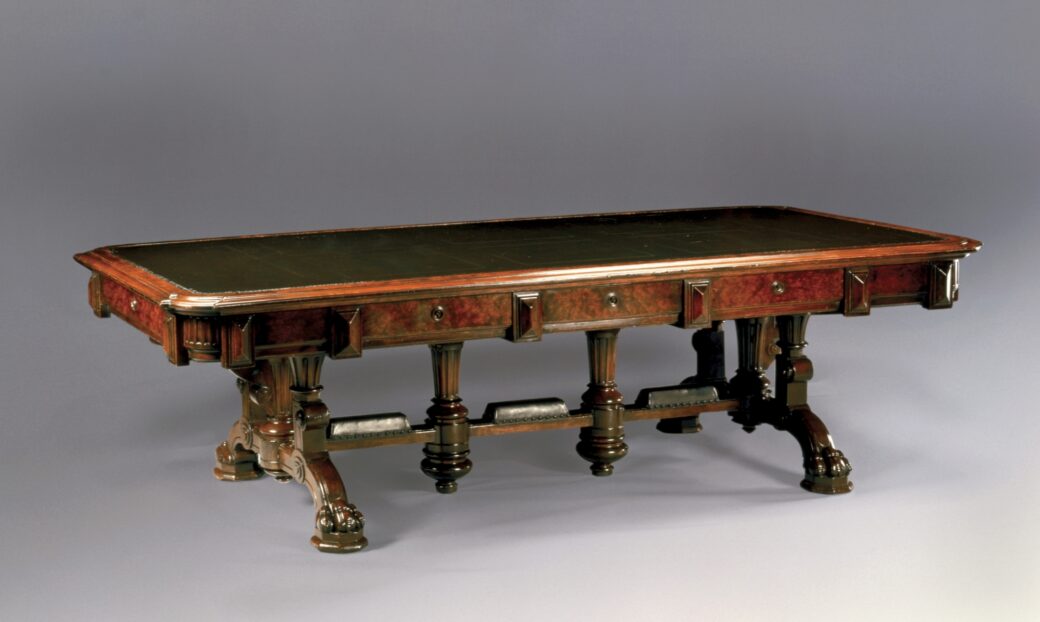
This walnut conference tabular array was purchased for the Cabinet Room (then on the 2d Floor of the White House) in 1869 during the assistants of President Ulysses S. Grant. Information technology was part of a suite of furniture made past the Pottier & Stymus Manufacturing Co., a New York firm known for its high-quality product uniquely designed for each commission.
An interesting feature of the tabular array are the locking drawers in which the President and his seven Cabinet officers (Land, Treasury, State of war, Justice, Post Role, Navy, and Interior) could keep their papers. It is uncertain how an 8th Cabinet fellow member was accommodated with the creation of the Department of Agronomics in 1889, only the table connected in apply until 1902, when a new Cabinet Room was provided in the newly constructed W Wing.
In 1961, Mrs. Kennedy retrieved the remaining pieces from the suite - this table, a sofa, and 4 chairs - and returned them to the 2nd Floor room which had served every bit the Cabinet Room from 1865 to 1902, naming it the Treaty Room in honor of the many documents which had been signed at that place.
The historic documents which accept been signed on this table include:
1. The Peace Protocol ending hostilities of the Spanish-American State of war, August 12, 1898, witnessed by President William McKinley in the Chiffonier Room.
2. The Pact of Paris (Kellogg-Briand Peace Pact), 1929, signed by President Calvin Coolidge in the E Room.
3. Arms and nuclear testing treaties with the Soviet Union signed in the E Room past Presidents Nixon (1972), Ford (1976), Reagan (1987), and (Bush-league) 1990
four. Treaties with onetime Soviet republics (Russian federation, Ukraine, Kazakhstan), 1992, signed by President George Bush-league in the East Room
5. Heart East peace documents: Egyptian-Israeli Peace Treaty, 1979, on the North Lawn, witnessed past President Jimmy Carter, The Israel-Palestinian Announcement of Principles, 1993, on the South Lawn, hosted by President Bill Clinton, The Washington Announcement, Jordan and Israel, 1994, on the South Lawn, witnessed by President Clinton, W Bank Understanding, Israel and the Palestinians, 1995, in the Due east Room witnessed past President Clinton, Interim Accord, Israel and the Palestinians, 1998, in the East Room.
Part of the Curator, The White Business firm
U.South. Government purchase, 1869
-
![Treasures of the White House: Dolley Madison]()
994.1737.1
This handsome portrait was painted past the historic artist, Gilbert Stuart, during his stay in Washington, 1803-1805. The great demand for the artist during this visit prompted a friend of Dolley Madison'south to report that "Stuart is all the rage. He is most worked to death, and everyone afraid they will be the terminal to be finished."
Dolley Madison, portrayed with her pilus arranged in a neoclassical style and wearing a fashionable high-waisted Empire-style dress, was the popular wife of James Madison, then Secretarial assistant of Land under President Thomas Jefferson. She often served as hostess at the White House for the widowed President.
In a letter to her sister, Anna Cutts, who was also painted by Stuart in 1804, Dolley Madison wrote, "Steward has taken an beauteous picture of Mr. Madison - his and mine are finished." James Madison deputed the portrait of his wife along with a companion likeness of himself for the Madison's Virginia home, Montpelier. They hung in the cartoon room of their home until after James Madison's death in 1836. The pair of portraits later on hung in her domicile on Lafayette Park in Washington, D.C.
Following Mrs. Madison'south death in 1849, the Madison portraits became the property of her son, Payne Todd. They were sold at auction in Washington. D.C., in March 1851, along with many of her other possessions. Anna Payne Causten, Mrs. Madison'south niece, and her husband purchased the portrait of Dolley Madison. Following their deaths, the painting was left to their girl, Mary Causten Kunkel. It was sold at sale in Philadelphia, on May 9, 1899, by Mrs. Kunkel and acquired past the Pennsylvania Academy of Fine Arts. In 1970, the Academy lent the portrait of Mrs. Madison to the White House. It was acquired for the White Firm collection in 1994.
Source: Office of the Curator, The White House
Gift of the Walter H. and Phyllis J. Shorenstein Foundation in memory of Phyllis J. Shorenstein, 1994
-
![Treasures of the White House: East Room Chandelier]()
902.3057.1
For the 1902 Theodore Roosevelt renovation of the White House, the architects McKim, Mead & White commissioned the noted New York firm Edward F. Caldwell & Co. to provide lighting fixtures. In the East Room were hung three massive electrical chandeliers fabricated of cut drinking glass and gilded brass past Christoph Palme & Co., Parchen, Bohemia (Austro-hungarian empire). Merely a year afterward the chandeliers were taken downwards and "the bore of the lower portion reduced in size". They were shortened and modified again during the Truman Renovation (1948-1952). Each chandelier currently consists of most 6000 pieces of drinking glass and weighs about 1200 lbs.
Part of the Curator, The White House
U.S. Government buy, 1902
-
![Treasures of the White House: George Washington]()
800.1290.1
On the afternoon of August 24, 1814, Dolley Madison received give-and-take at the White House from her husband the president that the British were about to march on Washington. He urged her to leave quickly. The British troops prepare burn down to the Capitol Building that evening, then a naval contingent moved on to the White House. While the naval officers ate the dinner that had been laid out for the Madisons, the sailors explored the house. Later piling upward the furnishings, they set them ablaze. The President's House was reduced to a shell, its contents consumed past the fire.
But Mrs. Madison had been determined that, in improver to official papers, the full-length portrait of George Washington painted by Gilbert Stuart must exist kept from British hands. In that location was no time to unscrew information technology from the wall, so the frame was broken and the sail on its stretcher carried from the business firm into the safety of the countryside. Not until 1817 was information technology returned to the rebuilt White House.
Although others had painted George Washington as armed services hero, it remained for Gilbert Stuart to create the authoritative image of the first president. No other portrait and so conveys the unyielding resolve and severe dignity that made him the embodiment of the immature Republic. Washington grasps a sheathed sword, emblematic of his military machine past and his nowadays position every bit Commander in Chief. His civilian clothes remind usa that later on the peace was accomplished in 1783 and the army disbanded, he had resigned his commission. This renunciation of power was so novel that information technology astonished Europeans also as his own countrymen. A folio volume of the Constitution and Laws of the United States leans against (symbolically, supports) the tabular array leg whose design joins elements of the fasces – the bound rods that symbolized authority and justice in the Roman republic–and the American hawkeye. Adjacent to the Constitution is a history of the American Revolution. We know from another version of the portrait that the title of the book adjacent to that one is Washington's General Orders, also recalling his military career. As well, the ii books on the table are The Federalist and The Journal of Congress. These remind us of his steadfast support of the federal matrimony and its Constitution.
The President's right arm is extended in one of the aboriginal Roman oratorical gestures, through which it echoes the ideals of the Roman republic. But the arm has been lowered and an imperious gesture modified by the contemporary English model of "conversation-slice" paintings in which men and women converse as equals.2 This is the man who had addressed Congress at his 1789 inaugural equally "boyfriend-citizens."
Garry Wills, in Cincinnatus: George Washington and the Enlightenment, has deftly summarized most of the other symbolic elements in this painting:
Stuart's portrait derives from the yard manner way of court painting in Europe during the 17th and 18th centuries; the artist borrowed freely from an engraving of a belatedly 17th-century French portrait in composing this painting. Merely by introducing different objects and symbols and by substituting an mental attitude of plain speaking for one of aristocratic hauteur, Stuart inverse the meaning of the borrowed forms.
Washington never posed for the standing figure. This was in accord with standard portrait practice: The sitter posed for the head only, with mayhap some chop-chop drawn notations of the torso and the extremities, while the body was painted from a surrogate model or fifty-fifty invented. The White House portrait is probably' the last of four nearly identical versions painted by Stuart, though at that place is no unanimity on the order in which the portraits were created. Since one of the iv was painted equally a souvenir to the Englishman Lord Lansdowne, all four are usually referred to as existence of the "Lansdowne type." The caput derives from a sitting in Apr 1796, requested specifically for utilize in painting the first full-length portrait.
Source: William Kloss, et. al., Art in the White Firm, New York: Abrams, 1992.
United States Authorities purchase, 1800
-
![Treasures of the White House: Hayes State Dinner Service]()
880.3840.i
In 1879, a state dinner service for President and Mrs. Rutherford B. Hayes was commissioned from Haviland & Co., Limoges, France. Subsequently a meeting with Mrs. Hayes in the White House conservatory, Theodore R. Davis, an artist for Harper'due south Weekly, who advocated a service designed with American flora and fauna, was asked to assume direction of the designs. From his drawings, etchings were produced for transfer of the outlines to many new dish shapes; basic coloring was applied by chromolithographic and decalcomania processes and and so shaded past decorators. The dinner platters (both extant) were described as painted with "a magnificent wild turkey, who struts through the lite snow, upon which are seen delicate reflections from his rich-colored feather...on this most perfectly American dish."
Some of the Hayes designs and forms were made for public sale as well, just on these the pennant mark dated 1879, unique to the White Business firm service, was replaced by a blue 1880 patent mark.
Office of the Curator, The White House
U.South. Government buy, 1880
-
![Treasures of the White House: Monroe Armchair]()
961.14.i
As part of the refurnishing of the White House after the fire of 1814, President James Monroe ordered for "the big oval room" (Blue Room) a suite of French mahogany furniture. The agents, Russell & LaFarge of Le Havre, however, substituted a suite of gilded beechwood furniture by the noted Parisian cabinetmaker, Pierre-Antoine Bellangé (1760-1844), asserting, that "mahogany is not more often than not admitted in the furniture of a saloon, even at private gentlemen's houses." The 53-slice was described on the 1817 shipping invoice as decorated with "olive branch ornaments, covered in double-warp satin, fine ruddy".
In 1860, 28 chairs (perhaps what remained of the original 38) along with the original complement of sofas, stools, footstools, and screens were sold at sale in Washington, D.C. But the pier table has remained continuously at the White Firm. Five armchairs, 2 side chairs, and i sofa have been returned to the White House since 1961. The two side chairs are the only pieces at the White House to bear traces of the maker'due south postage. A group of reproductions (seven arm and four side chairs) was made in 1962 to supplement the three original chairs acquired in 1961-62.
Office of the Curator, The White Business firm
Souvenir of Cathrine Bohlen, 1961
-
![Treasures of the White House: Lighter Relieving a Steamboat Aground]()
978.13392.ane
This painting brings to life an era and a region in which storytelling was at once a way of life and an art form. Bingham was raised on the banks of the Missouri River most St. Louis, and he became its historian. He knew the river well, and as a fellow he witnessed the change in its character every bit the flatboats that drifted with the electric current or were poled against it were supplanted past steamboats in the 1830s.
This is, equally far as nosotros know, the beginning painting in which Bingham depicted an accident on the river. The steamboat in the distance has run aground on a shoal, and this boat in distress probably alludes to a key political result of the day. Obtaining federal funds to improve navigation and thus facilitate merchandise on the western rivers through the removal of snags, shoals, and sawyers was a primary goal of the Whig party in Missouri. In 1846 Bingham ran as a Whig for the Missouri House of Representatives. He was elected, but the results were contested. The Democrat-controlled legislature decided against him, and he was forced from office. Before long later, to the fury of the Whigs, the Democratic President James 1000. Polk vetoed the River and Harbor Bill.
Although Bingham may indeed have had a political subtext in this painting, his primary focus is on the cocky-sufficient boatmen, his heroes. Having removed cargo from the steamer ("lightened" it and then it can float free from the shoal), they have turned from it to listen to their storyteller. In the words of Henry David Thoreau, Bingham's contemporary, they are "building castles in the air for which world offered no worthy foundation." Of this and another picture, a St. Louis reporter wrote that the artist has chosen "the simplest, most frequent and common occurrences on our rivers... precisely those in which the full and undisguised character of the boatmen is displayed."
Source: William Kloss, et. al., Art in the White Business firm, New York: Abrams, 1992.
Fractional gift of an anonymous donor, 1978, and Mr. and Mrs. Walter Shorenstein, 1981
-
![Treasures of the White House: Monroe Plateau]()
817.3673.1
As part of the refurnishing of the White House subsequently the fire of 1814, President James Monroe ordered for the dining room in 1817 a large gilded bronze plateau. Fabricated in the large and prominent Parisian shop of Jean-François Denière and François Matelin (circa 1797-1820), it was described as "mat golden with garlands of fruit and vines with effigy of Bacchus and Bacchantes and pedestals on which are sixteen Figures presenting wreathes for receiving lights [candles] and sixteen cups for irresolute at will, composed of seven pieces altogether thirteen [sic 14] anxiety 6 inches long, over 2 feet broad, set with its mirrors." It was accompanied past three baskets, a pair of urns, and a pair of stands, all extant.. In 1854, 32 cut glass dishes were caused every bit an alternative to candles.
Office of the Curator, The White House
White Business firm Historical Clan
-
![Treasures of the White House: Rocky Mountain Landscape]()
981.1468.1
When Albert Bierstadt painted Rocky Mountain Mural in 1870, he had non seen the Rockies for 7 years. He worked from studies made in 1863, during his 2d trip to the W. He had recently returned from a triumphal ii-year tour of Europe; the post-obit yr he would go westward again.
Bierstadt'southward dramatic sense was keen, and he was a master at the creative transformation of a few basic compositions. He adopted devices associated with the theater: The contrast of the darkened proscenium and wings with the low-cal-struck sky and water enhances the scene. The eye moves into the space by diagonal steps, from the family of deer (the only animate objects in the painting) just right of center, to the stand of trees, to the correct altitude, and to the soaring cathedral rock across the water. Finally, the virtually distant snowfall-covered peaks are seen at top left center. Against this Bierstadt develops a curvilinear play in the cuplike curves of rocks and lakeshore. With the clarity and spatial penetration of a stereographic view (his use of photography is well documented), he rivets our gaze. The innumerable oil sketches from which he composed his large canvases are typified by the brisk cloud study reproduced to a higher place. It is alive with the exhilaration of on-the-spot observation.
In Rocky Mountain Landscape the shopworn adjectives "spellbinding" and "breathtaking" regain their identity, conveying the awestruck wonder the artist induces in the viewer. Both words imply the pause of fourth dimension. The cascades suggest neither sound nor movement; the great cloudbanks are stopped in their ascent; the still water of the lake mirrors the rocks and locks them to the foreground shore through the circuitous and beautiful pattern of reflections.
We dare not motion lest nosotros lose the waking dream. No humans are present except ourselves; we have stumbled upon a hidden valley. The disposition of light and shadow furthers this illusion. Around a core of light the artist has wrapped a dark cloak, sealing off this boggling place from the civilized earth.
Source: William Kloss, et. al., Art in the White House, New York: Abrams, 1992.
Gift of The Barra Foundation, Inc., 1981
-
![Treasures of the White House: Sand Dunes at Sunset, Atlantic City]()
995.1759.one
One of Henry Ossawa Tanner's largest and most artistically ambitious landscape paintings is this cute littoral view of Atlantic City, New Jersey. Depicted in the late afternoon calorie-free, windswept sand dunes announced before an ocean covered with a depression brume that partially hides the sun. Upon shut examination, ane can run across that the creative person incorporated sand into the paint used to create the sand dunes.
Enticed past seasonal employment opportunities, Tanner visited Atlantic City many times during the summers of the 1870s and 1880s. Dewey F. Mosby in his biography of Tanner has suggested that this painting may originally accept been entitled, Back from the Beach, and was exhibited at the Pennsylvania Academy in 1885 and again at the National Academy in 1886.
Tanner, the son of an African Methodist Episcopal minister and a female parent who conducted individual school in her home, was born in Pittsburgh, Pennsylvania in 1859. At the age of twenty, he enrolled in the Pennsylvania University of Fine Arts and studied nether Thomas Eakins and Thomas Hovenden. Although he spent over half of his life in France where he constitute an expansive and more accepting environment, he e'er considered himself an American. He made periodic visits to the United States and served equally a lieutenant with the American Reddish Cross during World War I. On May 25, 1937, he died at his habitation in Paris.
This is the start work of art by an African-American creative person to be part of the White House collection. Acquired from Dr. Rae Alexander-Minter, grandniece of the creative person, information technology was donated to the White House by the White Business firm Endowment Fund.
Source: Part of the Curator, The White House
Souvenir of the White Business firm Endowment Fund, 1995.
-
![Treasures of the White House: Seymour Tall Case Clock]()
972.919.1
The case of this clock, a form frequently made in New England, is an important example of the superb craftsmanship of male parent and son cabinetmakers John and Thomas Seymour of Boston, circa 1795-1805. Made of mahogany with crotch birch and satinwood veneers, the 8'lO" case also features a double lunette inlay that was a sophisticated Seymour ornament. Although its punch is unmarked, the movement may take been fabricated past James Doull of Charlestown, Massachusetts, whose name appears on clocks with similar Seymour cases.
Caused in 1972, this clock has stood in the Oval Office since 1975 and is one of the nearly cute clocks in the White House collection.
Part of the Curator, The White House
Gift of the White House Historical Association, 1972
-
![Detail, Steinway Piano]()
This photograph of the detail on the Steinway pianoforte case was taken in the Lobby on July 20, 2017 by Matthew D'Agostino. The mahogany concert grand pianoforte with supporting eagles of aureate leafage was presented to the White House by Steinway & Sons on December x, 1938. The piano was designed by architect Eric Gugler who was also responsible for the 1934 expansion of the West Wing. The Entrance Hall is located on the State Floor of the White House.
White House Historical Association
-
![Treasures of the White House: The Lincoln Bed]()
861.threescore. 1
The massive rosewood bed known as the "Lincoln Bed" is believed to accept been purchased by Mrs. Lincoln in 1861 for use in the principal invitee bedchamber of the White Business firm. The popular reference to it every bit the "Lincoln bed" is derived not from its utilize by the Lincolns, only from its conquering during their occupancy of the White House.
Measuring eight'4" long and 5'lO 1/two" broad, it has a very alpine headboard, 93 1/iv" high, featuring an oval center console surmounted past an open, carved grapevine cresting on which are perched two exotic birds. A similar motif, with only one bird, is carved on the face of the much lower, arched footboard. Grape clusters, like those atop the pointed headboard stiles, are carved on the face of the rounded footposts.
An invoice dated May 29, 1861, from Wm H. Carryl and Bro., a Philadelphia retailer, includes, amid other purchases for the White Business firm, "1 Rosewood Bedstead" every bit part of a 10-piece suite of piece of furniture costing $800. Also on this invoice was "1 Rich Rosewood Centre Tabular array" which is believed to be an extant table similarly carved with grapevines and exotic birds.
An 1862 paper article quite fully describes this bed in its guest room setting:
The guests' room, now known every bit the Prince of Wales' room since that youth occupied it [Albert Edward, Prince of Wales, later King Edward VII, was received at the White Firm on Oct iv, 1860], has been thoroughly ornamented and refurnished... The master feature of the room is the bed. It is eight feet wide and nine feet long, of solid rosewood. The sides are cushioned and covered with royal figured satin. The caput board is a piece of rich carved work, rising eight feet above the bed, and having an oval top. Twenty feet above the flooring, overspreading the whole, is a magnificent canopy, from the upper carved work of which the drapery hangs in elegant folds, existence in the form of a crown, the front end ornament upon which is the American shield with the Stars and Stripes carved thereon." (Daily Alta California, San Francisco, May 12, 1862).
Although the awning with its patriotic shield ornamentation was certainly a special commission, it is unlikely that the bedstead itself was. Many examples of very similar beds are known to exist, some bearing makers' marks. This bed, however, is not marked in whatsoever manner to indicate its manufacturer.
The bed was used in various Second Floor bedrooms, including those of President and Mrs. Theodore Roosevelt, President Woodrow Wilson, and Grace Coolidge. In 1945, information technology was placed past President Truman in the room which had been Abraham Lincoln's role and cabinet room, which was so renamed the Lincoln Bedroom.
Office of the Curator, The White Firm
U.South. Regime buy, 1861
-
![Treasures of the White House: The Peacemakers]()
947.2558.i
The title is the merely inkling to the import of this solemn painting, a prelude to the finish of the Ceremonious War. Seated in the after cabin of the Union steamer River Queen are Maj. Gen. William T. Sherman, Lt. Gen. Ulysses S. Grant, President Abraham Lincoln, and Rear Adm. David D. Porter. Less than a week before the autumn of Petersburg, Virginia, the four men met to discuss the nature of the peace terms to follow.
The events leading upwardly to the scene recorded in The Peacemakers are these. Following his march through Georgia, Sherman with his army had turned to the Carolinas and, on March 19, 1865, had taken Goldsboro, North Carolina. Petersburg, the last defense of Richmond, where Gen. Robert E. Lee had gathered his forces, had been under siege by Grant'south regular army for nine months. The terminate of the Ceremonious War was at concluding imaginable.
On March xx Grant invited Lincoln to visit him at his headquarters at City Point, on the James River near Richmond: "Can you non visit City Point for a day or two? I would like very much to see y'all and I remember the residual would do y'all good."' Lincoln accepted this opportunity to relax while acquainting himself firsthand with the progress of the war. On March 24 he reached City Betoken on the River Queen. Sherman, according to his Memoirs, decided coincidentally to pay a visit to Grant at just this time, arriving on the evening of the 27th: "Subsequently I had been with him an hour or and so, [Grant] remarked that the President [was on the River Queen]. . . and he proposed that we should telephone call and see him."
Since Porter, in accuse of the Union armada on the James River, was also in Metropolis Point, he joined the others. On March 27 and again on the 28th, the iv gathered aboard the steamer. The start coming together was, according to Sherman, "a expert, long, social visit." During the 2d meeting their conversation, although wide-ranging, turned often to the decision of the peace. Only Sherman and Porter left written accounts, and some have suggested that they exaggerated Lincoln's want for peace, as Porter put information technology, "on almost any terms" in guild to justify Sherman's afterwards, controversial liberal surrender terms to Gen. Joseph Johnston. But Lincoln's generous intentions had been memorably formulated in his Second Inaugural Address, just iii weeks before: "With malice toward none; with clemency for all."
Following the coming together shown in The Peacemakers and preceding the end of the war by ane week, Petersburg roughshod on the dark of April 2 afterwards the long siege. Grant and Lincoln entered the metropolis the next solar day. On his render to the Marriage base at City Bespeak, Lincoln told Porter: "Thank God I have lived to see this. Information technology seems to me that I accept been dreaming a horrid dream for iv years, and now the nightmare is gone. I want to see Richmond." Together they sailed upriver to the defenseless upper-case letter of the Confederacy. In that location Lincoln, less than a fortnight before his assassination, walked the streets amidst a swelling throng of emancipated black people.
The Peacemakers documents in measured accents this turning point of American history. Its somber figures–less actors than audition–await the denouement, the Confederate surrender at Appomattox Courtroom Firm, Virginia.
Source: William Kloss, et. al., Fine art in the White Firm, New York: Abrams, 1992.
United States Authorities purchase, 1947
-
![Treasures of the White House: Thomas Jefferson]()
962.395.ane
This compelling likeness of Thomas Jefferson as Vice President, together with the creative person's 1795 portrait head of George Washington (Historical Social club of Pennsylvania, Philadelphia), is the triumph of Peale's career. He painted both his early masterpieces before report in Paris in 1808–10, which denaturalized his fresh, direct vision and infected his manner with a classicizing way.
The portrait of Jefferson was completed in Philadelphia before mid-May 1800, when he left that capital for Monticello. An engraving of the portrait past Cornelius Tiebout was published on Feb twenty, 1801, less than two weeks before Jefferson became the outset President to exist inaugurated in the new upper-case letter city of Washington. The engraving, widely circulated in the The states and abroad, became the public image of Jefferson the President (1801-09).
Again and again one reads of Jefferson'southward serenity; this portrait confirms it. As a presentation of the harmonious nature and balanced intellect of the man, it is unequaled. The confront has the glow of health, a warm complexion that bespeaks a warm personality. In contrast to the subjects in many early on presidential portraits, the sitter here looks straight at united states of america and does so with candor, as our equal. The splendid eyes and mouth convey reason and tolerance. It is an inherently autonomous movie and a fitting summation of the century just concluded, the Age of Enlightenment.
But it is equally an announcement of a new historic period in America's political life. During the John Adams Assistants the deep rifts between the Federalists and the Jeffersonian Republicans had taken a bitterly personal turn, and the animosity of the campaign of 1800 was intense. When the election was thrown into the House of Representatives, where it remained deadlocked for 35 ballots, civil war was spoken of. Jefferson's ballot on February 17, 1801, could not terminate the turmoil, but Jefferson himself could. It is an easy thing to match the face up in this portrait with the sentiment expressed in Jefferson's kickoff inaugural address on March 4, a reasoned and ungrudging reminder that every departure of opinion is not a difference of principle: "Nosotros have chosen by dissimilar names brethren of the same principle. We are all Republicans, nosotros are all Federalists. If there be any amongst u.s. who would wish to dissolve this Union or to alter its republican form, permit them stand undisturbed every bit monuments of the rubber with which error of stance may be tolerated where reason is left free to combat information technology."
Source: William Kloss, et. al., Art in the White House, New York: Abrams, 1992.
Gift of Mr. and Mrs. Paul Mellon, 1962
-
!["Resurrection" in the Vermeil Room]()
Titled "Resurrection," this acrylic and graphite on canvas painting was washed by Alma Thomas in 1966, who was an educator and artist in Washington, D.C. for most of her career. She was a fellow member of the Washington Color School. This painting was unveiled every bit role of the White Firm Collection during Black History Calendar month 2015 and is the first in this collection by an African American woman. This photograph shows the painting on display in the Vermeil Room, during a printing preview of the White Business firm holiday decorations on November 30, 2020. The holiday theme for 2020 was America the Beautiful, which celebrated the natural wonders of the American landscape. Selected by First Lady Melania Trump, the White House decorations too paid tribute to the backbone and resilience of frontline workers, members of the military, and other American heroes. In 2020, American frontline and essential workers faced unique challenges due to the COVID-nineteen pandemic.
Matthew DAgostino for the White Firm Historical Association








Source: https://www.whitehousehistory.org/galleries/the-white-house-collection
0 Response to "Academy of the Fine Arts Founded in 1805 and Led by Thomas Eakins in the 1880s"
Enregistrer un commentaire